
“You are looking at a coward. I saw the way things were going, a long time back. I said nothing. I’m one of the innocents who could have spoken up and out when no one would listen to the ‘guilty’, but I did not speak and thus became guilty myself.” (Faber, from Fahrenheit 451 by Ray Bradbury.)
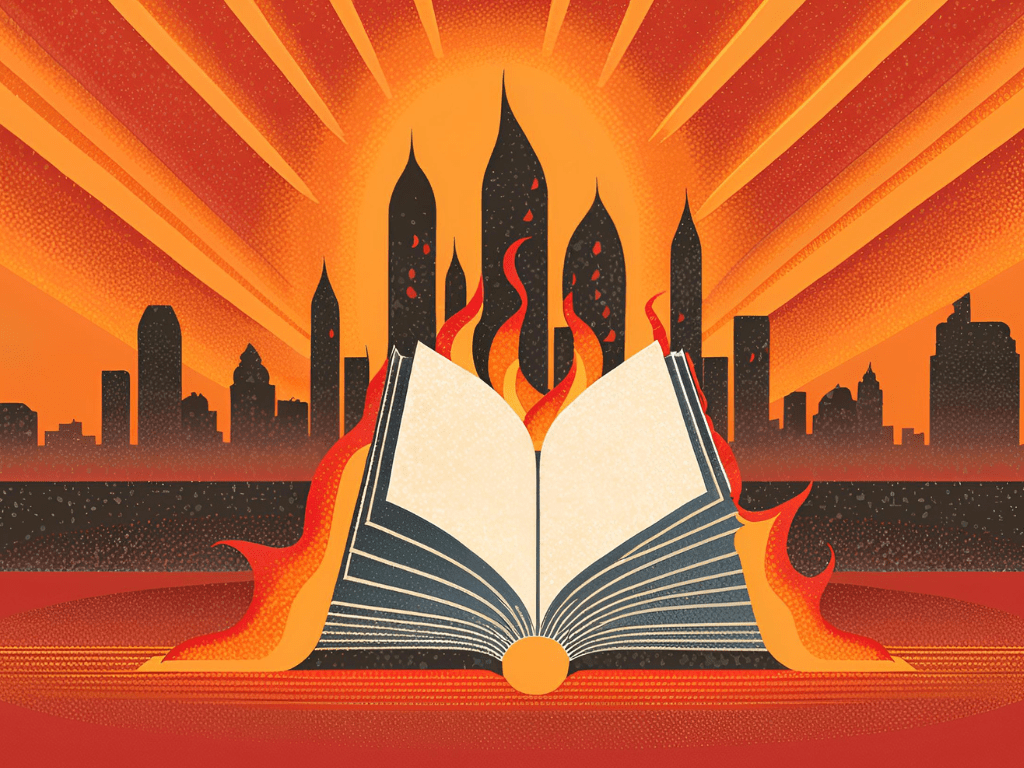
In 1950, the American novelist Ray Bradbury authored, what was then titled, The Firemen, and later republished as Fahrenheit 451. The dystopian novel depicts an alternative future where firemen rode trucks and responded to emergency calls, but not to extinguish fires. Their task was to ignite them for the explicit purpose of burning books and the contents of the homes that contained them.
“I’m one of the innocents who could have spoken up and out when no one would listen to the ‘guilty’, but I did not speak and thus became guilty myself.”
There are few novels written in the last one-hundred years as captivating and still relevant as Bradbury’s Fahrenheit 451. It serves as both a critique and a warning to our modern society from the not-so-distant past. Bradbury portrays a technologically advanced nation at atomic war while the people live apathetic to the sound of bombers in the sky, the needs of their neighbors, and the concerns of the world. It’s an alternative reality deprived of human emotion, depth, and the diversity of ideas and dreams that once came vividly through books. In their place is the endless stream of superficial digital entertainment broadcast into dimly lit homes where people live together, but exist alone.
As the story goes, a once complicit and silent Faber encourages Montag, a shaken and “woke” fireman desperately searching for new answers. “You mustn’t go back to being just a fireman,” Faber tells Montag. “All isn’t well with the world.”
In today’s nonfiction reality, it’s not firemen but politicians, ideologues, and power brokers burning our books, ideas, rights, and dreams.
As concerned people of our time, our purpose is not to go back but forward in healing a world that isn’t well. Human rights are increasingly disregarded. Inclusion of diversity, expression, and belonging are becoming restricted or expunged. Books, ideas, and people are doxed, banned, or punished. Solutions to climate change are left unaddressed. And the sounds of war are in the air.
In today’s nonfiction reality, it’s not firemen but politicians, ideologues, and power brokers burning our books, ideas, rights, and dreams. While many accept complicity or chase false enemies, we watch in horror the inferno of injustice occurring before our eyes. This moment demands a morality that can only come with clarity. For those who see, we must not remain silent in cowardice but stand with uncommon courage. Our loved ones and neighbors near and far are counting on us.

 Matt Till