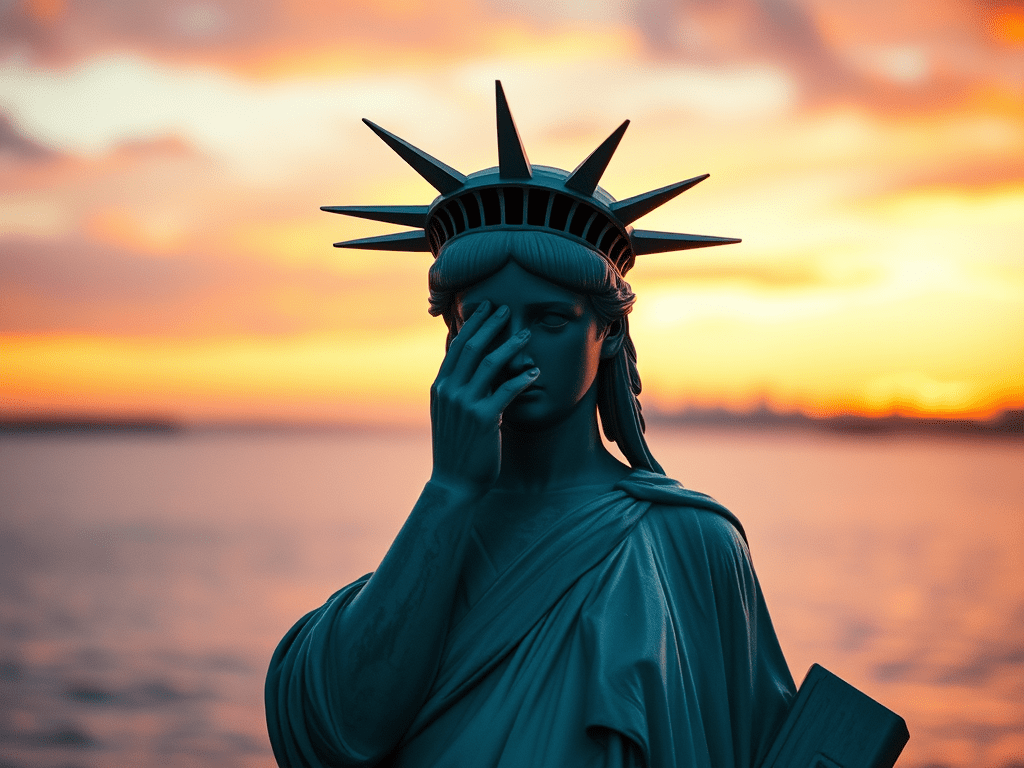

Last week, America chose a once-unimagined moment in its nearly 250-year history. With the re-election of Donald Trump, the most extremist president ever elected in the United States, something deeper than a partisan victory has been revealed about us as a nation: we, as a society, are not okay.
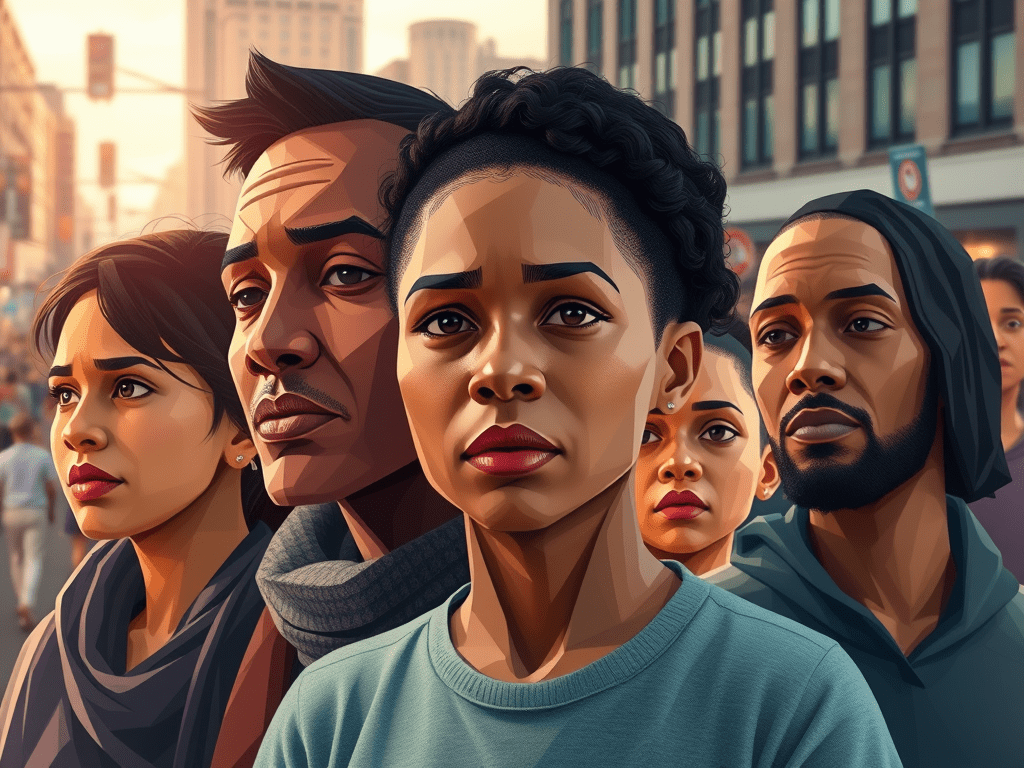
The overwhelming perception of the direction of our country is not positive. According to exit polls, 73% of voters reported feeling dissatisfied or angry about how things are currently going in the United States.[1] Consumed by these feelings, the majority of voters chose to overlook the facts of Trump’s attempt to overthrow the 2020 election, incite an insurrection, his felony charges, abuse of women, demeaning and racist rhetoric, and ominous promises to eliminate his political opposition and be a dictator on day one.
We, as a society, are not okay.
Instead of rejecting such a leader, Americans did the opposite. Voters overwhelmingly chose an abusive father figure over a steady and empowering mother. Surprising to many, Trump’s narcissistic persona attracted an even larger movement to his message of anger, grievance, and grandiose promises to be our nation’s savior and protector –– a future embodied in the image of an unstable, dystopian strongman.
The stark reality we face is an unsettling one. Someone reflected earlier this year, “Our boys are not okay,” and clearly, they are not. Instead of choosing to side with its moral character and virtuous potential, America succumbed to its repressed pain.
A Call for Self-Examination
Understanding this moment requires an honest assessment of the human condition and the present reality. Albert Einstein once wrote, “Everything that the human race has done and thought is concerned with the satisfaction of deeply felt needs and the [alleviation] of pain.”[2] At the top of voters’ minds were issues that everyday people struggle with and perceive as the source of their unmet pain. While issues like the economy and immigration mattered in this election, the ever-growing uncertainty of our collective future created a potentially devastating self-inflicted wound.
More Americans chose to satisfy their earthly desires over their spiritual, moral calling.
Decades of wars, economic crises, climate change, and mounting fear, resentment, and distrust of the government catalyzed a larger movement that rallied around a failed strongman to make him even stronger. “Trauma,” according to Dr. Gabor Maté, “imposes a worldview tinged with pain, fear, and suspicion: a lens that distorts and determines our view of how things are.”[3] In other words, clouded by anxious and dissonant perceptions resulting from unresolved traumas in a changing and complex world, the majority of Americans felt it necessary to make way for an exploitive and oppressive power system to meet their needs instead of creating space for new possibilities.
The 2024 election will serve as a definitive point in history as evidence of the social malaise we are living through. Citing Einstein and thousands of years of religious teaching, more Americans chose to satisfy their earthly desires over their spiritual, moral calling.
A Call for Healing
The status quo is no longer acceptable. Compassion and holistic solutions are needed from humble, courageous, and clear-eyed members of society. The data reveals the sobering truth, and so have our conversations with family, friends, and neighbors. The change we require must support the evolution, sustainability, and thriving of humanity in the world –– not seek to exploit or crush it.
Hope is never lost and faith in a better tomorrow is not dead.
This means that great ideas are urgently needed. Thankfully, they’re already out there in the world in the unseen spaces being designed, tested, and implemented. Like most ideas in their infancy, they require the intelligence, experience, and resources of others to refine and activate them to their fullness. Professionals, non-professionals, students, and everyday people alike in our interconnected world can promote healing, expand our horizons, produce meaningful outcomes, and create a better world that benefits us all. Hope is never lost and faith in a better tomorrow is not dead.
A Call for Leadership
This moment in time is calling upon each of us. Now more than ever, we need leaders in every space of our society who will promote healing over tyranny, collaboration over isolationism, innovation over nostalgia, and empowerment over exploitation. We need leaders who understand the values that cultivate a more desirable and inspiring world for everyone. We need leaders who are capable and proven to lead with integrity, humility, and courageous resolve. We need leaders who recognize we’re at our best when we embrace a plurality of ideas but at our worst when we conform systems, organizations, and institutions to homogeneous worldviews.
Now more than ever, we need leaders in every space of our society who will promote healing over tyranny, collaboration over isolationism, innovation over nostalgia, and empowerment over exploitation.
Nearly 80 years ago, on December 10, 1964, Dr. Martin Luther King Jr. received the Nobel Peace Prize and gave a prophetic address to the world. It became a foundation for the human rights movement and peace in global conflicts. As we face the uncertainty of tomorrow, his words linger as the echos of a past where great progress was made while the work remained unfinished. Today, his words speak to us as a vision of what is still possible.
I believe that unarmed truth and unconditional love will have the final word in reality. This is why right, temporarily defeated, is stronger than evil triumphant.
I believe that even amid today’s mortar bursts and whining bullets, there is still hope for a brighter tomorrow.
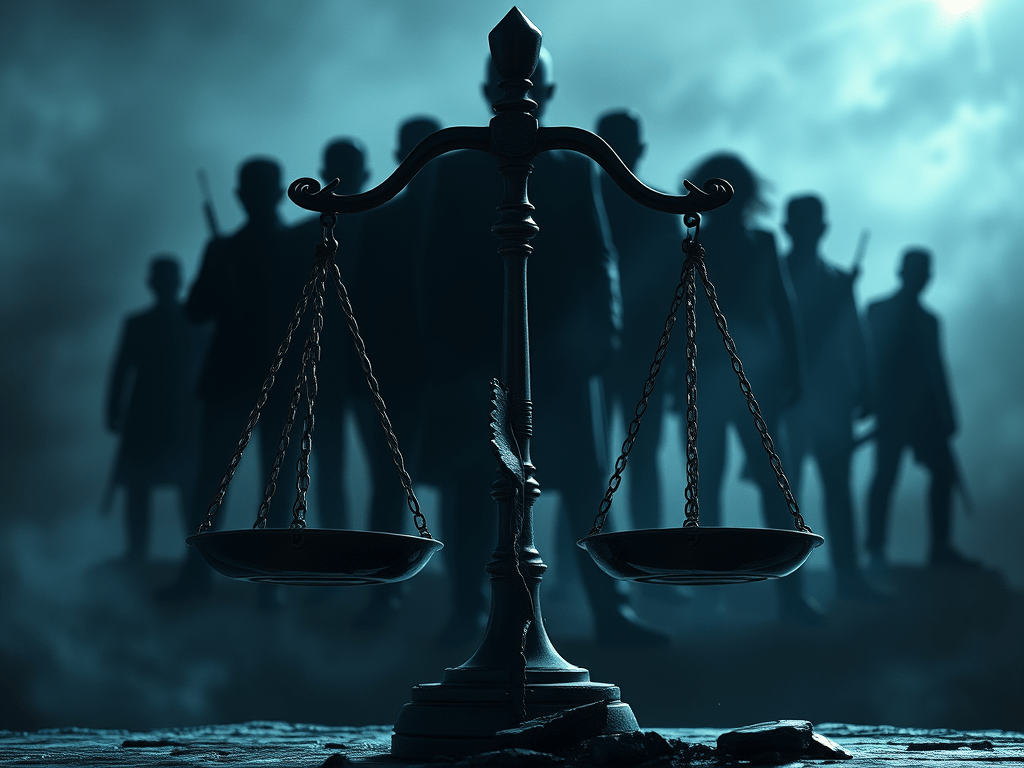
I believe that wounded justice, lying prostrate on the blood-flowing streets of our nations, can be lifted from this dust of shame to reign supreme among the children of men.
I have the audacity to believe that peoples everywhere can have three meals a day for their bodies, education and culture for their minds, and dignity, equality, and freedom for their spirits.
I believe that what self-centered men have torn down, men other-centered can build up.[4]
[1] https://www.cnn.com/election/2024/exit-polls/national-results/general/president/0
[2] Albert Einstein, “Religion and Science,” New York Times Magazine, November 9, 1930, in Ideas and Opinions by Albert Einstein (Namaskar Books, 2023), 44, Kindle.
[3] Gabor Maté, The Myth of Normal: Trauma, Illness & Healing in a Toxic Culture (New York: Avery, 2022), 32.
[4] Martin Luther King, Jr, “Acceptance Address for the Nobel Peace Prize,” in A Call to Conscience, ed. Clayborne Carson and Kris Shepard (New York: Grand Central Publishing, 2002), 107.

 Matt Till