
It can seem that every day we read or hear about how we’re living in “unprecedented times.” It’s hard to deny that social norms, orders, and expectations are changing at an increasing rate – to the degree that can make us feel like strangers in our communities. The advent of the Information Age – largely defined up to this point by the development of the internet and smartphones – has been the most disruptive change agent in the modern era. From local and global economies to social capital and interpersonal relationships, nearly every aspect of life has been impacted and will continue to evolve with the adoption and transformative impact of this new age we now live in.
Such a time can feel uncertain, deeply unsettling, or downright terrifying. From local jobs to entire fields being radically upended in today’s economy, or the viral spread of misinformation, the increase of fraudulent schemes, state-sponsored propaganda, and cyberattacks –– in times of rising existential fears –– it’s admittedly difficult to know who or what to trust.
The Shift in Power
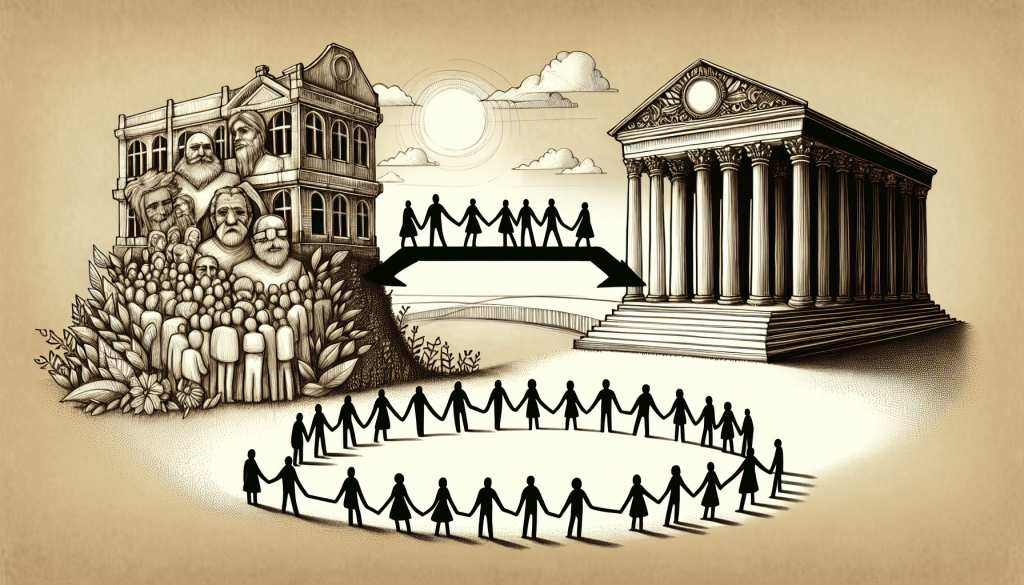
Until recent history, the social order has been mostly defined and led by institutions and the people who run them. Today, we are well into the growing pains created by the most significant shift in human history. That shift is a steady move from institutional authority to collaborative influence. In other words, the modern world is moving toward a common understanding that our founding documents, religious texts, laws, politicians, employers, or elite power brokers are insufficient to hold ultimate authority over every matter of life. Instead, we’re uncovering the simple fact that social order is constructed within the context of our shared humanity in awareness and relationship to one another.
Today, we are well into the growing pains created by the most significant shift in human history. That shift is a steady move from institutional authority to collaborative influence.
If this sounds like a radical concept, consider the inevitable world we are inheriting. Increasingly, no single person or institution is capable of solely leading or shaping our lives in the future. Despite the false promises of strong-man politicians or fear-based conspiratorial theories of oppressive new world orders, the world is too big, nuanced, connected, interdependent, and self-empowered for any one thing to exert universal power or influence. As a result, the future is not authoritarian, a competition to be won, or a strategic problem to be solved. The future is collaborative.
An Inflection Point in Human History
Never before in history have everyday individuals been able to affect and shape their future without privileged access. This too, is a result of the tremendous shifts created by the Information Age. A brief look at public attitudes toward longstanding institutions, power structures, players, and politicians reveals an increasingly untenable sentiment toward their role as positions of authority or gateways to influence society. And for those who sit in the very positions in question, privately (and sometimes publically) they express dismay and frustration toward the constituents they claim to serve. We live in both empowering and divergent times.
Never before in history have everyday individuals been able to affect and shape their future without privileged access.
The modern world is facing an inflection point in human history. Its significance on the timeline of our relatively young existence will certainly impact the trajectory of our future. How we as humanity choose to live with the ever-growing awareness of ourselves, each other, and the universe in light of a complex future will have lasting implications for us and our children.
From Competition to Collaboration
Humanity has regularly – and sometimes catastrophically – engaged in zero-sum games at the detriment of the planet and one another. Is this how intelligent life is designed to function and ultimately thrive? If, in that reality, the world is only made of winners and losers, the outcome seems clear: armed with our ever increasing technological advancements, we can expect the worst of humanity to fulfill our most apocalyptic fears.
Alternatively, we can begin to embrace the emerging world we live in when we believe there’s a better outcome made possible by our underappreciated and untapped instincts to desire goodness and wholeness for ourselves and others. In this reality, despite our anxieties and disagreements, the resilience of global societies will be defined by those who reject nihilism as our destiny. Instead, they will be known for their intuitive belief there is always a better and more holistic solution.
In a time where the existing structures of authority, order, and safety are dissolving, the story we tell ourselves of the future will matter more than the stories of the past. Will our story be defined by pragmatic competition or a shared collaborative? No single person or entity can decide that for us.


 Matt Till